09.09.2026
Kazakhstan achieves a high level of alignment with OECD international standards in statistics
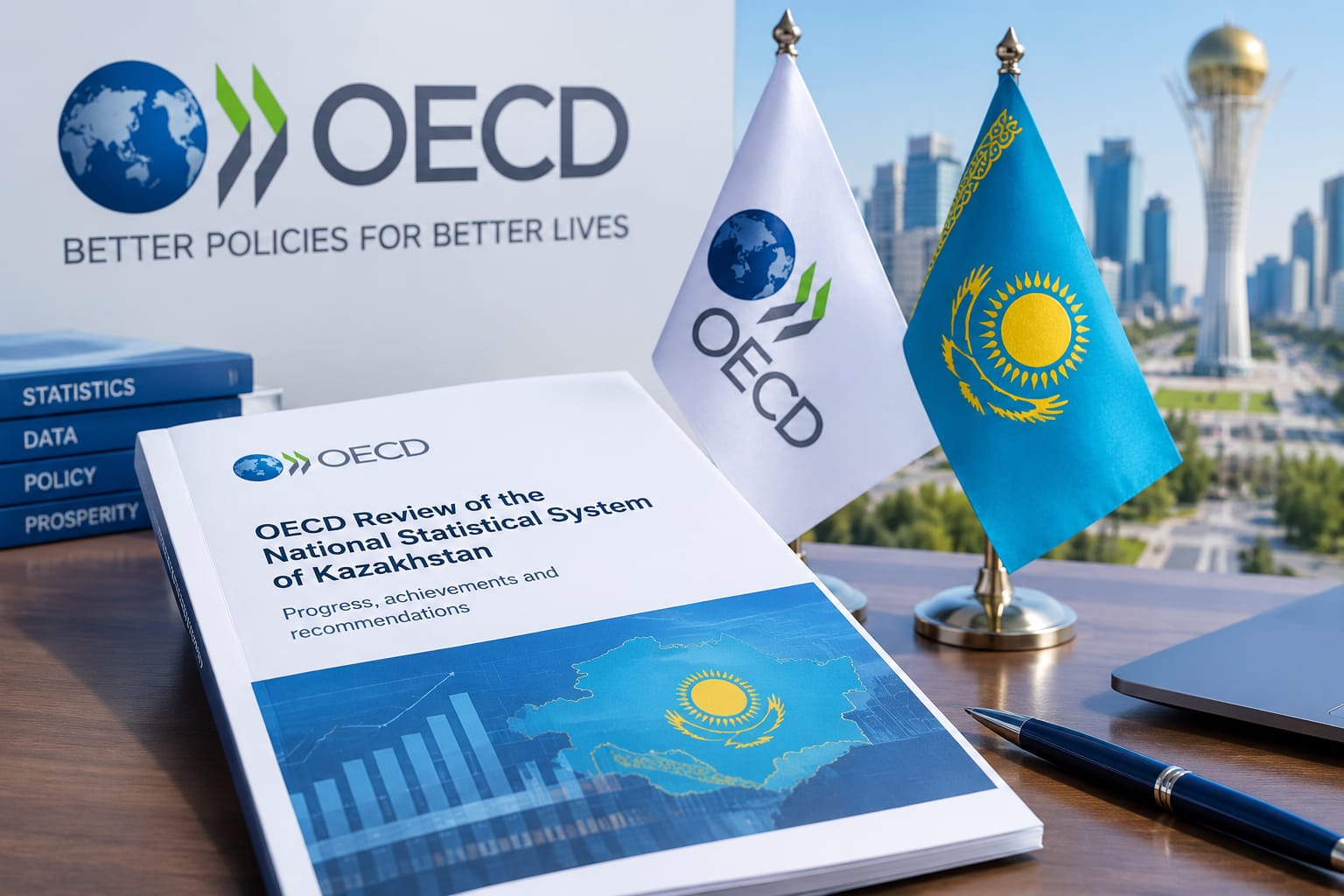
The Organisation for Economic Co-operation and Development (OECD) has published the final report on the results of the in-depth Review of the National Statistical System of Kazakhstan. According to the OECD experts’ assessment, “in most areas reviewed, official statistics in Kazakhstan are close to full alignment with the Organisation’s best policies and practices.”
The assessment covered key dimensions of the quality of official statistics, including accuracy and reliability, coherence, compliance with international standards, coverage and relevance, timeliness, accessibility and interpretability of data.
“In most subject areas considered, official statistics in Kazakhstan are close to full alignment with OECD best policies and practices,” the final report notes.
The OECD particularly highlighted the large-scale modernization of the national statistical system and the introduction of modern approaches to the production of official statistics.
Among Kazakhstan’s key achievements, OECD experts highlighted:
- the development of digital statistical registers and their integration with data from government authorities;
- the active use of administrative data and improvements in their quality;
- the digitalization of statistical data collection and processing;
- the use of alternative data sources, including fiscal receipts and mobile positioning data;
- reducing the reporting burden by moving from traditional surveys towards the use of data from digital sources;
- the gradual transition to a register-based population census model;
- a high level of alignment with international statistical classifications, concepts and methodologies.
According to the OECD assessment, the transformation undertaken by Kazakhstan is in line with current international trends in the development of official statistics.
One of the most important outcomes of the reforms is the transition from a model based predominantly on traditional surveys towards next-generation statistics based on the integration of administrative, transactional and other alternative data sources.
The development of digital statistical registers, the expanded use of new data sources and the digitalization of statistical processes make it possible to improve the timeliness and quality of information while reducing the reporting burden on businesses and citizens.
The development of artificial intelligence and automation technologies is becoming increasingly important, creating new opportunities for processing large volumes of data, detecting anomalies, classification, forecasting and improving the efficiency of statistical production.
The in-depth Review was conducted in 2023–2025 at the initiative of the Bureau of National Statistics of the Agency for Strategic Planning and Reforms of the Republic of Kazakhstan. As part of the review, OECD experts conducted three in-person visits to Kazakhstan and carried out a detailed assessment of the legal, institutional, methodological and technological foundations of official statistics production.
The Review covered virtually the entire range of national statistics, from national accounts, price and labor market statistics to business statistics, international trade, income distribution, well-being and environmental-economic accounting.
The OECD’s positive assessment confirms the effectiveness of Kazakhstan’s efforts to digitally transform statistics, expand the range of data sources and improve the quality of official statistical information.
An important milestone in bringing the Bureau of National Statistics into alignment with international standards was Kazakhstan’s adherence in 2025 to the OECD Council Recommendation on Good Statistical Practice.
Kazakhstan became the first CIS country to adhere to this instrument, which establishes international benchmarks for the quality, reliability, objectivity and transparency of official statistics.
Alongside its recognition of the progress achieved, the OECD experts identified areas for further improvement of the national statistical system.
In particular, the OECD recommended continuing to develop:
- public sector debt statistics;
- structural business statistics and business demography statistics;
- environmental-economic accounting;
- trade statistics broken down by business characteristics.
At the same time, the OECD noted that Kazakhstan is already undertaking work in a number of these areas, including efforts to improve the coverage and interpretability of data, metadata documentation and the level of detail provided.
The OECD recommendations will be taken into account in the further development of Kazakhstan’s national statistical system.
The OECD final report is available on the Organisation’s official website: OECD Reviews of National Statistical Systems: Kazakhstan 2026 (https://www.oecd.org/en/publications/oecd-reviews-of-national-statistical-systems-kazakhstan-2026_f7...)
Back to the list